

Insurance in Blackjack: Strategy, Odds and Payouts
Insurance bet in blackjack is one of the most discussed features at any blackjack table, especially in major Australian online casinos like Zoome. Whether you’re playing blackjack for the first time, hitting blackjack often, or practising solid blackjack strategy, understanding insurance is essential for minimising losses and playing at peak efficiency. Explore every aspect below—from blackjack insurance rule mechanics to expert advice on when to use it and why basic strategy and advanced blackjack strategy usually say to avoid it.
How Blackjack Insurance Bet Works
Insurance in blackjack is a side bet that’s offered only when the dealer's up card is an Ace. The dealer will always ask, "insurance open?" giving you the option to protect your original bet if you believe the dealer has blackjack. You place this side bet (up to half your original wager) in the insurance line of your blackjack table.
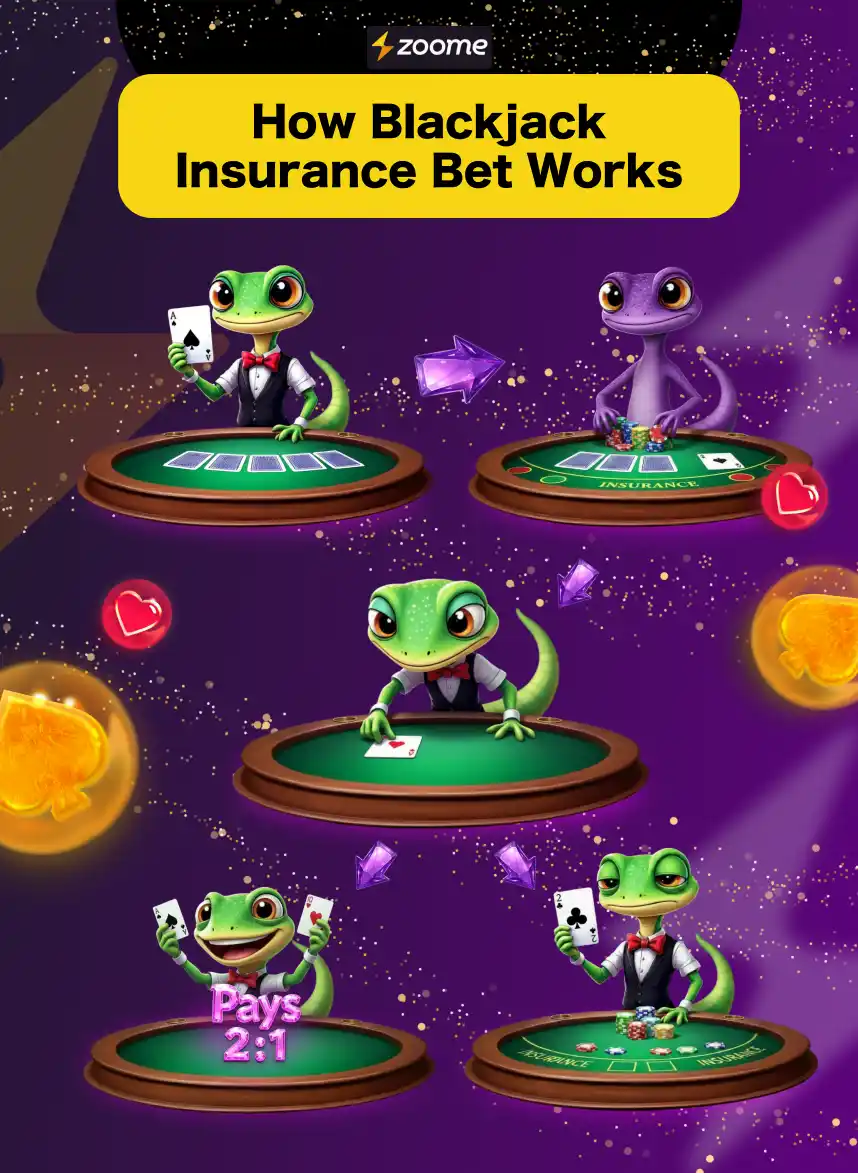
If the dealer’s hole card is a ten value (10, J, Q, or K), and thus forms blackjack, insurance bet pays 2:1. This is intended to compensate your lost main wager. For example, with a $40 original bet, you place a $20 insurance bet; if dealer hits blackjack, you lose your main hand but receive $40 for the insurance—breaking even. In most games, you'll be playing blackjack with multi-deck shoes, but insurance rules remain the same.
When the Dealer Shows an Ace
Whenever the dealer shows an ace as an up card (also referred to as the dealer's face up card or ace up card), the offer for an insurance bet is immediately available. The presence of the dealer's up card as an ace is the trigger for the insurance offer, allowing players to hedge against the risk of losing their original bet to a potential dealer blackjack. However, the dealer doesn’t always have blackjack; only about 30-31% of the time will the hole card be a ten value, making the insurance side bet appealing in theory—yet, in reality, it’s a bad bet for most blackjack players.
Offering of Insurance
The dealer typically announces the option after all initial cards are dealt but before any further action. The insurance line becomes active and each player gets to decide independently whether to take insurance. This is the same both in physical casinos and when playing blackjack online such as at Zoome, where you’ll see an insurance prompt on screen.
Betting Half Your Original Bet
The insurance bet must always be no more than half your original bet (rounded down if necessary). If your original wager is $50, the insurance side bet can be up to $25. The design is simple: the insurance bet pays 2:1, covering your main wager if the dealer has blackjack, so you don’t lose money on a round when you have a strong hand but still lose to a natural blackjack.
Pays 2:1 If Dealer Has Blackjack
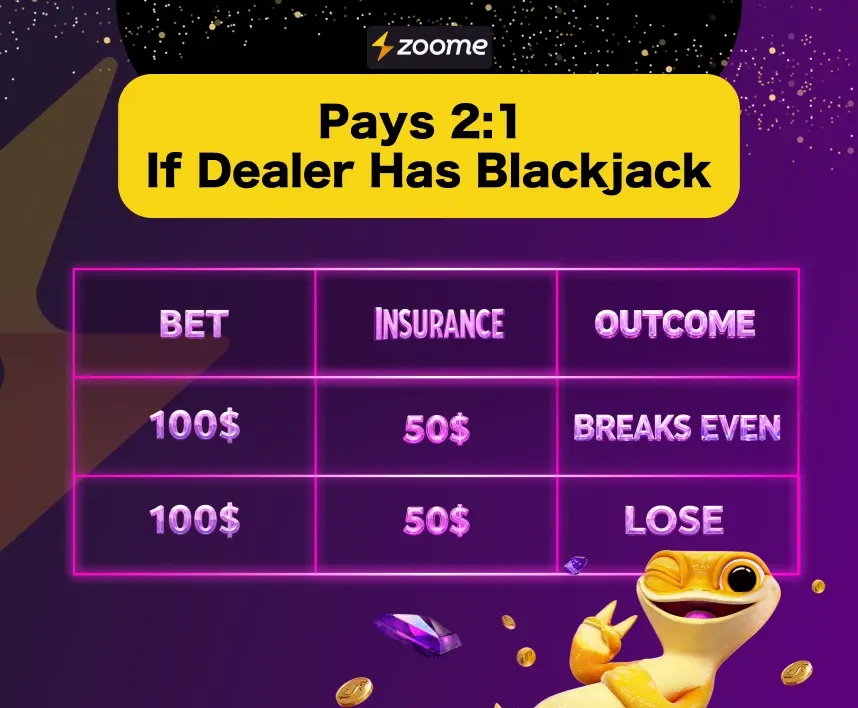
If the dealer's hole card is a ten value and completes a natural blackjack, insurance bet pays out at 2:1. This means you recover the amount lost from your own hand—essentially breaking even on the round. However, if the dealer fails to hit blackjack, the insurance bet is lost, leaving you to play your own hand as usual. Long-term, this payout structure gives the house edge a boost on the insurance side bet, not the player.
Should You Take a Blackjack Insurance Bet?
Many players are tempted to take insurance in blackjack, especially when they’ve wagered a significant amount and the dealer shows an ace. On the surface, the insurance bet seems like a safety net, providing relief against losing your original bet if the dealer has blackjack. However, this impression can be misleading: deciding whether to accept this side bet requires weighing both immediate outcomes and the long-term mathematical impact.
When evaluating insurance in blackjack, it’s crucial to move beyond instinct and consider the true risk versus reward. The odds that the dealer's hole card is actually a ten-value card are always lower than you might assume. The math, deck composition, and house edge all play bigger roles than simple intuition, especially in multi deck games or when not counting cards.
Pros and Cons
Below is a concise summary of the pros and cons of taking the insurance bet. Understanding these helps any player make more informed decisions at the blackjack table:
|
Pros |
Cons |
|
Mitigates loss on a dealer blackjack |
House edge is high (up to 7.5%+) |
|
Provides psychological comfort |
Only correct as a “winning strategy” for card counters |
|
Useful when betting big on a single round |
Most games result in a net loss over time |
|
Can be used with advanced card counting |
Bad bet for most, especially in multi deck games |
If you’re looking to explore more chance-based games in between blackjack sessions, the pokies online games section at Zoome Casino features hundreds of classic and modern slot titles for all budgets. For fans of classic casino tables, don’t miss the range of roulette games, with European, American, and special variants offering unique patterns of risk and reward.
Hit Blackjack: Risk vs. Reward
In a single deck game, there are 16 ten-value cards and 49 remaining unknowns when the dealer shows an ace. This means the actual odds don’t match the 2:1 payout; instead, the true odds are 2.25:1. The dealer's odds of having a blackjack are calculated by dividing the number of ten-value cards left in the deck by the number of remaining unknown cards, and these dealer's odds directly impact the expected value of the insurance bet, making it a losing proposition for most players. Over thousands of rounds, players lose money taking insurance bets, except for rare scenarios detected by expert card counters using a sophisticated card counting system. In multi deck games most casinos run, the odds tilt even further toward the house.
House Edge Explanation
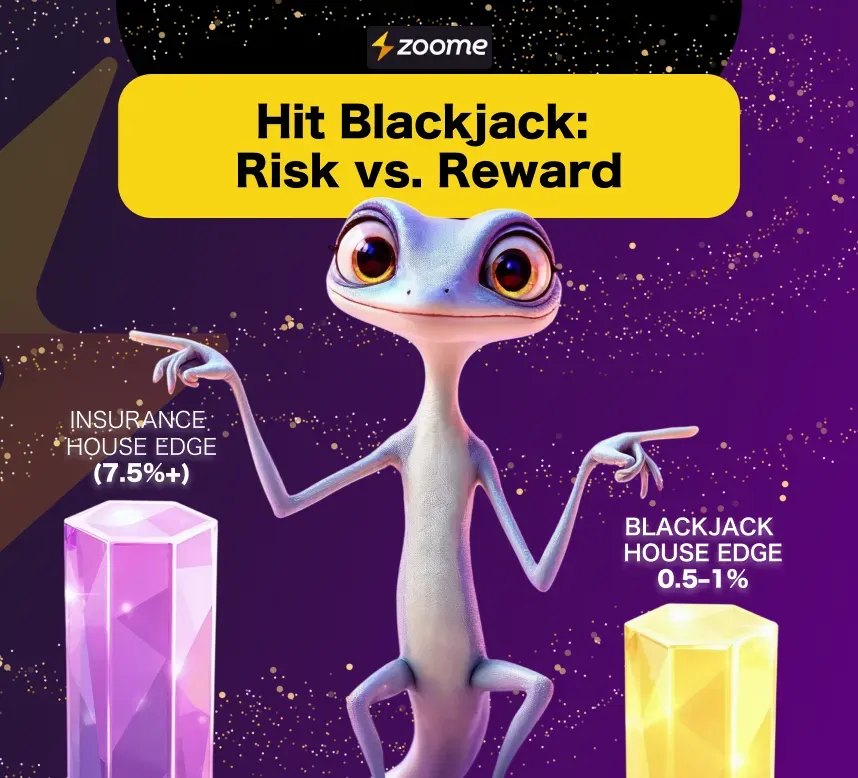
The house edge on the insurance bet is significantly higher than on the main blackjack game. In a typical six deck game, the house edge is about 7.5%; in an eight decks game, it’s around 7.47%. By contrast, sticking to basic strategy on the main game can keep the house edge down to 0.5%–1%. For most blackjack strategy situations, insurance is simply a losing proposition—an example of a sucker's bet.
When Is Insurance a Good Option in Blackjack?
Advanced blackjack strategy sometimes uses the insurance bet in particular circumstances. Here’s when it can make sense:
- You’re Counting Cards: When using a card counting system (like Hi-Lo or Omega II) and you know extra ten value cards remain, the expected value of an insurance bet can swing positive.
- True Count Is Positive: For experienced card counters, a high true count (typically +3 or above in a six deck game) signals the rare times when it’s mathematically correct to take insurance in blackjack.
- Advanced Players Can Profit: Only those who keep perfect track of cards, such as professionals or dedicated semi-pros, can exploit this gap. Most casual blackjack players cannot access this data in live or online casino play.
Players who enjoy the real-time excitement of an interactive floor can join the live online casino arena, playing blackjack, roulette, or baccarat with real dealers in high-definition video. Those looking for a taste of card sophistication beyond blackjack can visit the baccarat online casino room, playing dealer-versus-player for simple, fast-paced hands and side bets.
When to Avoid the Insurance Bet
While insurance in blackjack might look like a helpful safety net, seasoned blackjack players know it is usually a losing proposition, especially for casual players or those not employing a card counting system. Let’s examine why most players should decline this side bet and the common pitfalls to avoid when playing blackjack at any level.
- Casual Players: If you’re not actively counting cards, the insurance bet isn’t in your favour. Taking it often or blindly will make you lose money, as the house edge is simply too steep.
- Standard Probability Disadvantages: The insurance bet seems at first to “protect” against big losses, but the actual odds are always worse than the 2:1 payout. Over an extended session, players will lose more often than not.
- Common Mistakes: Players commonly take insurance in blackjack during a losing streak or after losing a big hand, or if they’ve just been dealt blackjack. None of these situations change the negative expected value. Stick to basic blackjack strategy and skip this bet unless you are intentionally using card counting.
Basic Strategy: Playing Blackjack Without Insurance
Following basic strategy is proven to reduce the house edge for the main blackjack game, unlike the insurance side bet. Players should instead:
|
Hit Blackjack |
If their hand total is less than 12, or the dealer’s up card is strong; only stop with a solid total or soft hand. |
|
Double Down |
When charts and blackjack strategy dictate, such as with a hard 11 against a low dealer upcard. |
|
Split and Stand |
Based strictly on the house rules and the dealer’s up card, not on luck or hunches. |
|
Ignore Insurance and Side Bets |
For sustained long-term wins, never take insurance unless you’re counting accurately in a favourable deck. |
Prefer a blend of skill and luck? Try best online poker, where experienced card sharks and beginners alike can join cash tables or tournament-style competitions for real rewards. Fans of lottery-style quick wins will appreciate keno online casino, where instant draws provide another way to win money with minimal effort.
Blackjack Strategy: Should You Ever Take Insurance?
For most blackjack tables, even single deck blackjack, the insurance bet is best ignored. The only exception comes in multi deck games with proven true count advantages—illustrating the importance of knowing the game structure and count at Zoome or any top online casino Australia venue.
Advanced blackjack strategy tells us:
- Never take insurance on instinct or to “protect” a high original bet.
- Use insurance exclusively when card counting gives you an edge.
- Practice disciplined bet sizing; don’t chase losses with side bets.
- Be aware of game rules (does the blackjack table pay 3:2 or 6:5 for blackjacks; do surrender or even money apply).
Following these rules creates a disciplined approach, maximising your chances of win money outcomes in the long run.
Example Payout Table
Seeing the actual numbers behind the insurance bet is the fastest way to grasp its financial impact. Here is a practical payout table that shows what can happen to your original bet and insurance bet in different dealer scenarios.
|
Scenario |
Main Bet |
Insurance Bet |
Dealer Hand |
Payout |
|
Dealer has blackjack |
$40 |
$20 |
Ace + 10 value card |
Break even |
|
Dealer does not blackjack |
$40 |
$20 |
No ten in hole card |
-$20 or more |
The expected value over many hands means casino world odds favour the house. In fact, taking insurance in blackjack will almost always see the average player lose money with each additional bet.
Finally, players chasing mega prizes can spin for life-changing payouts in Zoome’s online jackpot slots, renowned for their huge progressive jackpots and the thrill of every spin.
What Is Even Money in Blackjack?
Even money is an option offered when you’re dealt blackjack and the dealer’s up card is an Ace. By declaring "even money," you accept a guaranteed 1:1 payout on your original bet, instead of risking a push (tie) if the dealer has blackjack. Mathematically, it’s identical to taking insurance—with the same expected value and house edge, but it saves you waiting for the dealer to check the whole card.
In both online and land-based play, always evaluate whether forfeiting the potential 3:2 payout is ever worthwhile. For most, even money is just insurance "rebranded" and isn’t part of a solid blackjack strategy.
Blackjack Insurance vs. Even Money: Mechanics & Math
Although insurance and even money might seem different at first glance, these two options function almost identically in practice. Let’s compare their mechanics and examine the surprising math that connects them, clarifying when each appears in a standard blackjack game.
|
Feature |
Insurance Bet |
Even Money |
|
When Available |
Dealer shows Ace |
Player hits blackjack, dealer shows Ace |
|
Stake |
Up to half original bet |
1:1 payout on main bet |
|
Payout |
2:1 if dealer blackjack |
1:1—avoids push |
|
Math |
Negative EV except for pros |
Negative EV for most |
|
Seen In |
Any blackjack game/table |
Special hand only |
Knowing this comparison keeps you focused on expected value, not intuition or fear of losing a big winning hand.
Playing Blackjack Online: How Insurance Works at Zoome
At Zoome Casino, blackjack insurance is offered in all major titles—Single Deck Blackjack, Multihand Blackjack, Blackjack Lucky Ladies, and more. You’ll see a prompt or a special insurance line on the table layout, and the rules (essentially betting half your original bet, 2:1 payout) are always made clear.
This same side bet appears in other top card games, but blackjack is the casino game where it’s most common. Always check the game summary for details and review what bonuses, like casino bonus codes, are on offer to offset your risk.
Advanced Examples: Sucker’s Bet or Winning Opportunity?
Looking at insurance through real-world examples helps show when, if ever, this bet shifts from losing proposition to a viable play. Here are common—and rare—scenarios that reveal exactly when insurance is a classic “sucker’s bet” and when it’s a secret weapon for advanced players.
Scenario 1: Casual Player
You’re playing a multi deck game, dealer shows an ace, and the table offers insurance. There’s no card counting system in use, so the insurance side bet is a losing proposition and a classic “sucker’s bet.”
Scenario 2: Expert Card Counter
You’re deep into a six deck game, have tracked many low-value cards, and your true count tells you tens are abundant. Here, insurance in blackjack can have a slightly positive expected value. Only in this specific situation does advanced blackjack strategy recommend taking the bet.
Summary: Is Insurance Bet in Blackjack Ever a Good Idea?
Insurance bet in blackjack is a well-known but rarely justified side wager. It might seem reasonable—especially after a long losing session or when you fear a big win will be lost to a dealer blackjack—but in reality, this “protection” leads to consistent losses for most players. For the vast majority, following basic strategy, focusing on the main hand, and seeking value in bonuses and smart play is the real winning strategy.
Use insurance in blackjack only if you’re a card counter reading a positive true count, or if you are comfortable with the negative expected value in exchange for psychological comfort. Otherwise, decline the offer every time—focus on hitting blackjack the right way, apply advanced strategy where appropriate, and enjoy a safer, smarter edge against the casino world.